PAH Emission Spectra
a new method for modeling PAH heating and emission in arbitrary radiation environments
Polycyclic aromatic hydrocarbons (PAHs) are small carbonaceous molecules observed in and around galaxies, with spectral emission features that can be dominant in the mid-infrared. With JWST, we can now map PAH emission in unprecedented detail, including in the dusty outflows of nearby galaxies. Interpreting these observations requires models of how PAHs are heated and how they emit. Because PAHs are so small, a single absorbed photon can heat them to high temperatures, after which they cool by emitting in their infrared bands. Computing the resulting emission spectrum normally means solving for the full temperature distribution of each PAH, which is expensive to do for every radiation field of interest.
In Richie & Hensley (2026), we take advantage of the single-photon limit for PAH heating and emission. When photon absorptions are rare enough that each one can be treated as an independent event, the emission spectrum becomes a sum over contributions from individual absorbed photons. This means we can precompute a set of basis spectra, the emission produced by a PAH of a given size and charge after absorbing a photon of a given wavelength, and then simply scale and sum them to get the emission spectrum for any input radiation field.
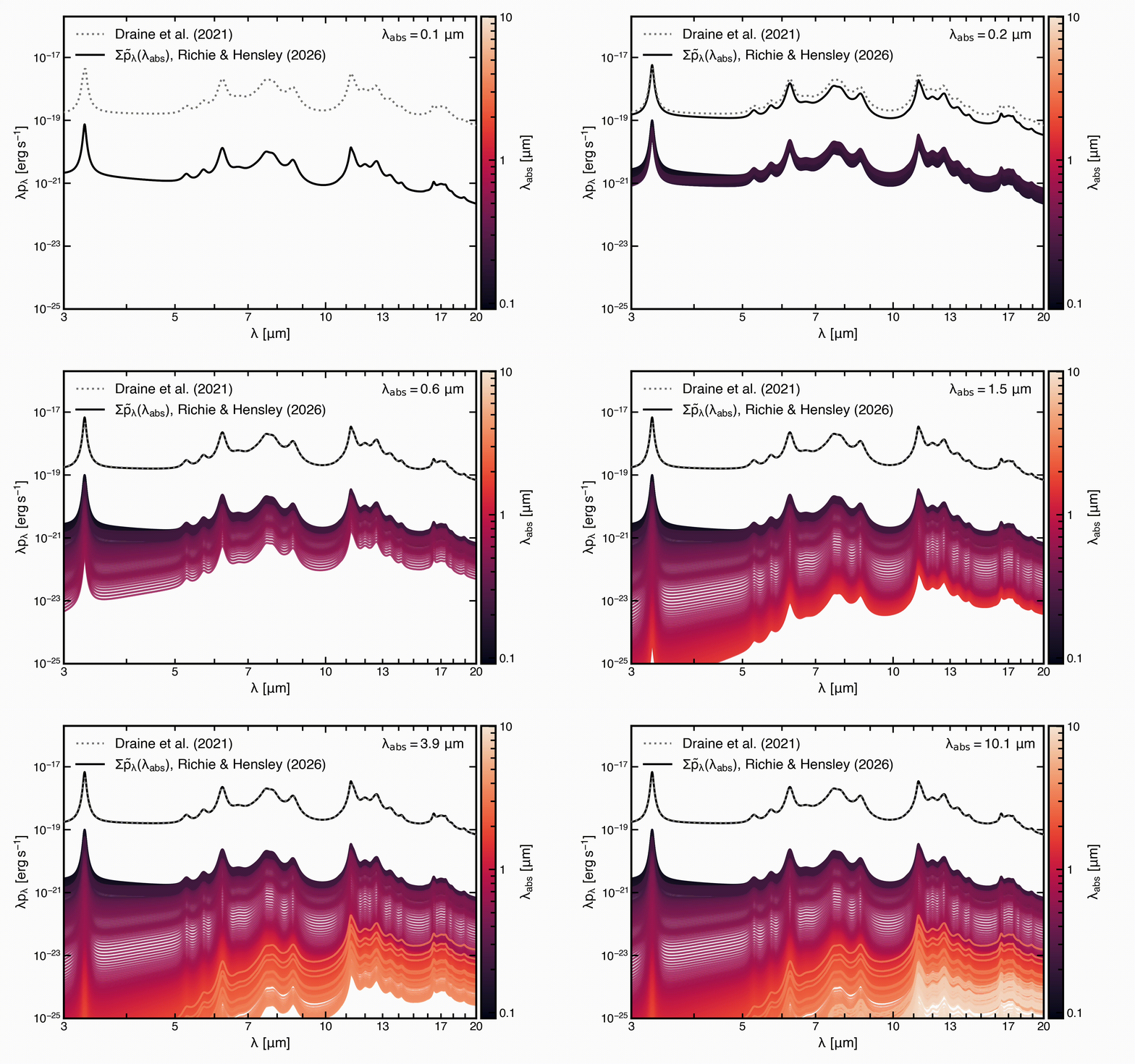
This approach agrees with spectra computed with full multi-photon heating to within \(\approx10\%\) over the 3–20 \(\mu\text{m}\) range for radiation field intensities \(U<100\). Because generating a spectrum is fast, it’s easy to explore how PAH emission responds to the shape of the radiation field. For example, we find that the 3.3/11.2 \(\mu\text{m}\) band ratio depends strongly on the hardness of the radiation field, which is important to account for when using band ratios to infer PAH sizes.
pah_spec
To make this method easy to use, I developed pah_spec, an open-source Python package for fast, flexible computation of PAH emission spectra with the single photon approximation. Full documentation is available on Read the Docs.
The core of the package is the PahSpec class. Given a radiation field and size distributions for neutral and ionized PAHs, PahSpec.generate_spectrum() combines a precomputed set of basis spectra to return the emission spectrum of both populations. The package can be installed with pip, after which the internal data and sample basis spectra can be downloaded:
python -m pip install --user git+https://github.com/helenarichie/pah_spec
python -m pah_spec download --to-cache all
A minimal example looks something like this:
import pah_spec

ps = pah_spec.PahSpec()

# PAH size distributions for neutral and ionized grains (Draine et al. 2021)
dn_neu, dn_ion = pah_spec.calc_dn(ps.grain_sizes, size_dist="st", ion_frac="st")

# wavelength_arr [um] and u_lambda_arr [erg/cm^4] describe your radiation field
spectrum_neu, spectrum_ion = ps.generate_spectrum(
    wavelength_arr=wavelength_arr,
    u_lambda_arr=u_lambda_arr,
    size_dist_neu=dn_neu,
    size_dist_ion=dn_ion,
)
All inputs and outputs are astropy quantities, so units are tracked throughout. Example notebooks for generating spectra and generating basis spectra are included in the repository.
By default, pah_spec uses the PAH absorption cross-sections and size distributions of Draine et al. (2021). It is also designed to be extensible: users can supply their own functions for absorption cross-sections, vibrational energies, and vibrational mode energies, then use PahSpec.generate_basis_spectra() to compute a new set of basis spectra for their own model of PAH physics. See the customization guide for details.
If you use pah_spec in your work, please cite Richie & Hensley (2026).